Electrochemical energy storage
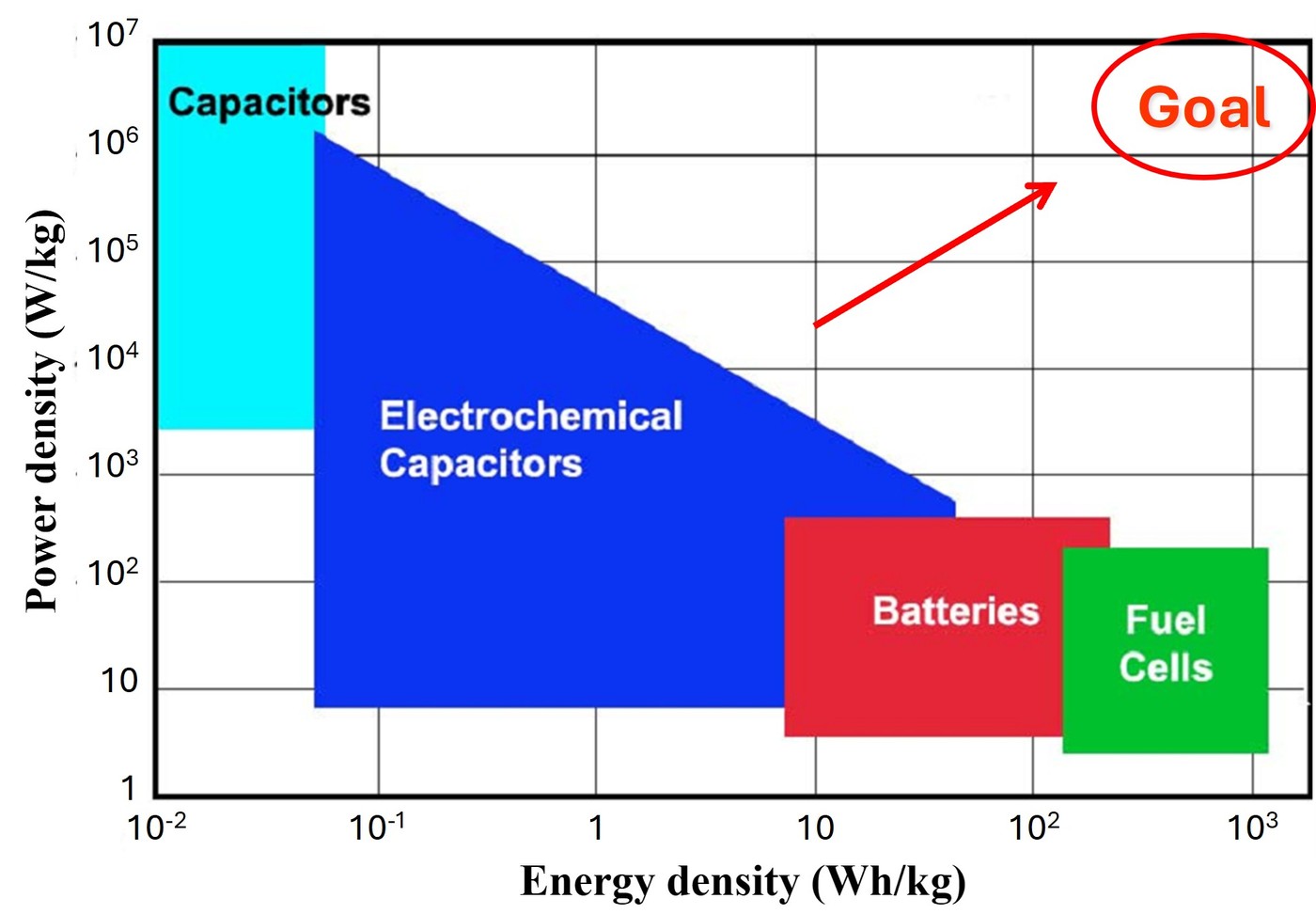
Electrochemical capacitors and lithium-ion batteries are essential to electrify transportation and to integrate renewable energy into the electric grid. Electrochemical capacitors, including electric double layer capacitors (EDLCs) and pseudocapacitors, deliver high power and long cycle life by storing charge through ion adsorption at electrode/electrolyte interfaces and fast surface redox reactions. Lithium-ion batteries store more energy through ion intercalation in the bulk of the electrode materials, but charge more slowly and generate heat that accelerates aging.
Our team develops continuum models and operando thermal and electrochemical measurements to understand the coupled interfacial, transport, and thermodynamic phenomena governing charge storage in both types of devices. We first focused on electrochemical capacitors, providing physical interpretations of standard electrochemical measurements and the first rigorous models and measurements of their heat generation. We then extended these tools to lithium-ion battery electrodes and cells, using operando calorimetry and potentiometric entropy measurements to reveal fast-charging and degradation mechanisms in new electrode materials.
Modeling of interfacial and transport phenomena in electrochemical capacitors
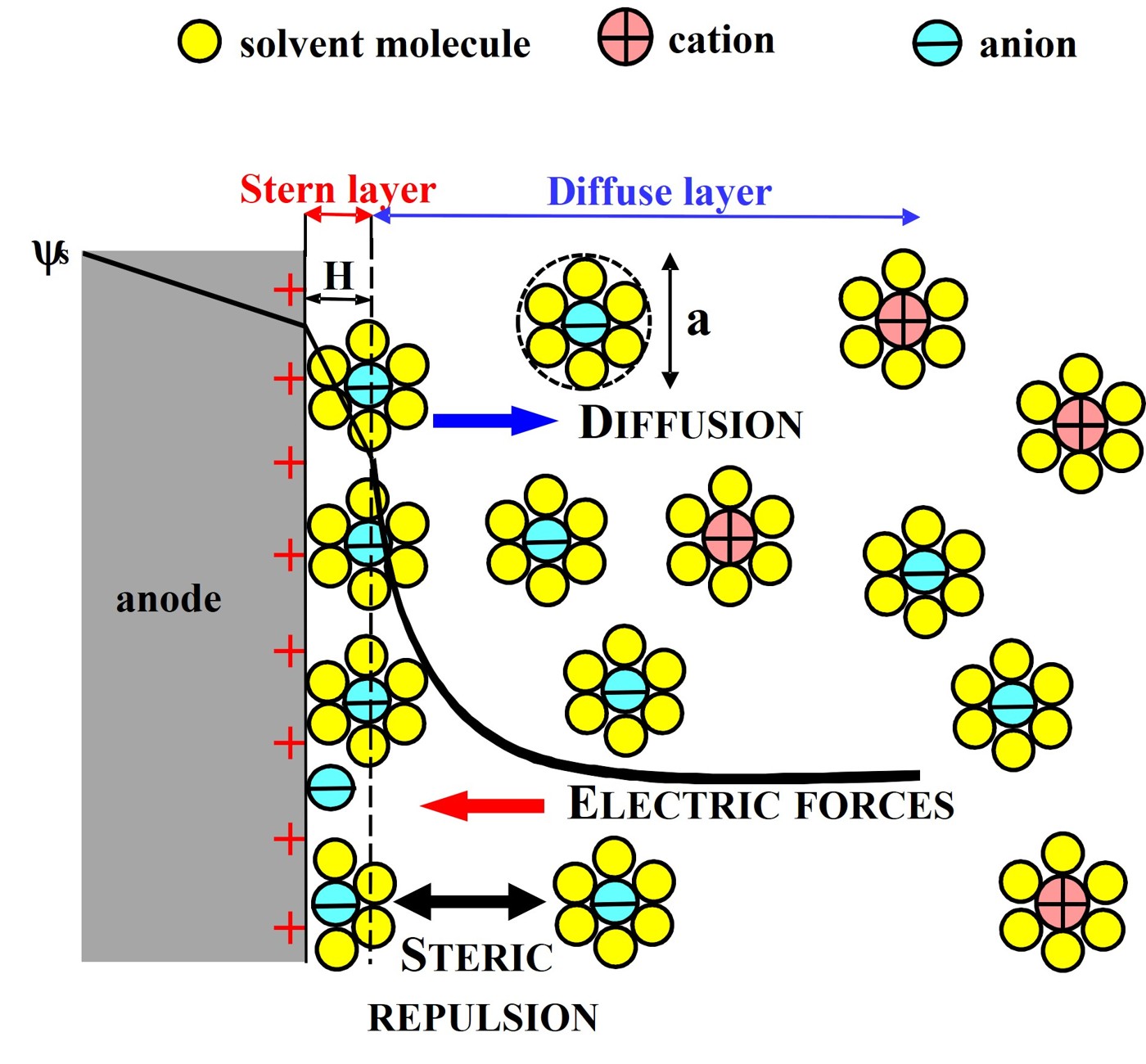
Over the last 15 years, our team has provided physical understanding of complex and coupled interfacial and transport phenomena that common experimental methods have been unable to distinguish. This effort was motivated by the need to move beyond the limitations of "ideal" physical models (dilute solution, ions treated as point charges, low voltage) to describe how actual electrochemical capacitors (large concentration, steric repulsion, high voltage) behave under dynamic conditions.
Two key papers summarize the rigorous modeling framework developed by our team [1] and generalize the model to any electrolyte [2].
- [1]L. Pilon, H. Wang, and A. d'Entremont, Recent Advances in Continuum Modeling of Interfacial and Transport Phenomena in Electric Double-Layer Capacitors, Journal of the Electrochemical Society (invited), Vol. 162, No. 5, pp. A5158-A5178 (2015).DOIPDF
- [2]H. Wang, A. Thiele, and L. Pilon, Simulations of Cyclic Voltammetry for Electric Double Layers in Asymmetric Electrolytes: A Generalized Modified Poisson–Nernst–Planck Model, Journal of Physical Chemistry C, Vol. 117, No. 36, pp. 18286- 18297 (2013).DOIPDF
Physical interpretation of conventional electrochemical measurements
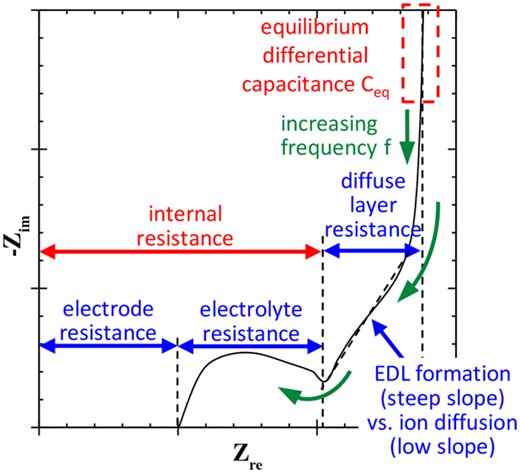
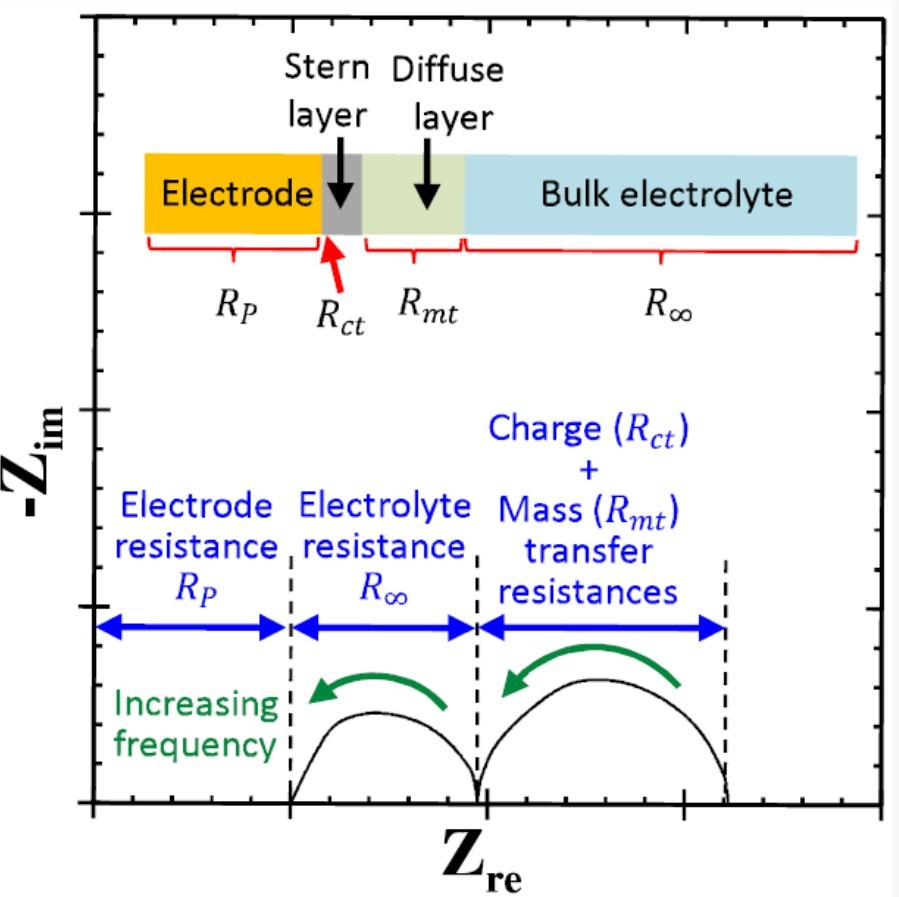
Following the development of a realistic continuum modeling framework, our team solved the coupled governing equations numerically to reproduce actual electrochemical measurements. By varying the transport properties of the solid and liquid phases in the electrochemical capacitor, we provided physical interpretations of commonly used methods such as electrochemical impedance spectroscopy (EIS) [3, 4] and cyclic voltammetry. We also demonstrated numerically, for 1D and 3D electrodes, the validity of the Step Potential Electrochemical Spectroscopy method developed in 2015 by Scott Donne’s group (University of Newcastle, Australia) [5].
- [3]B.-A. Mei, O. Munteshari, J. Lau, B. Dunn, and L. Pilon, Physical Interpretations of Nyquist Plots for EDLC Electrodes and Devices, Journal of Physical Chemistry C, Vol. 122, No.1, pp. 194-206 (2018).DOIPDFExplainer
- [4]B.-A. Mei, J. Lau, T. Lin, S.H. Tolbert, B. Dunn, and L. Pilon, Physical Interpretations of Electrochemical Impedance Spectroscopy of Redox Active Electrodes for Electrical Energy Storage, The Journal of Physical Chemistry C, Vol. 122, No. 43, pp. 24499-24511 (2018).DOIPDF
- [5]O. Munteshari, Y. Zhou, B.-G. Mei, and L. Pilon, Theoretical Validation of the Step Potential Electrochemical Spectroscopy (SPECS) and Multiple Potential Step Chronoamperometry (MUSCA) Methods for Pseudocapacitive Electrodes, Electrochimica Acta, Vol. 321, 134648 (2019).DOIPDF
First-principles thermal models of heat generation in electrochemical capacitors
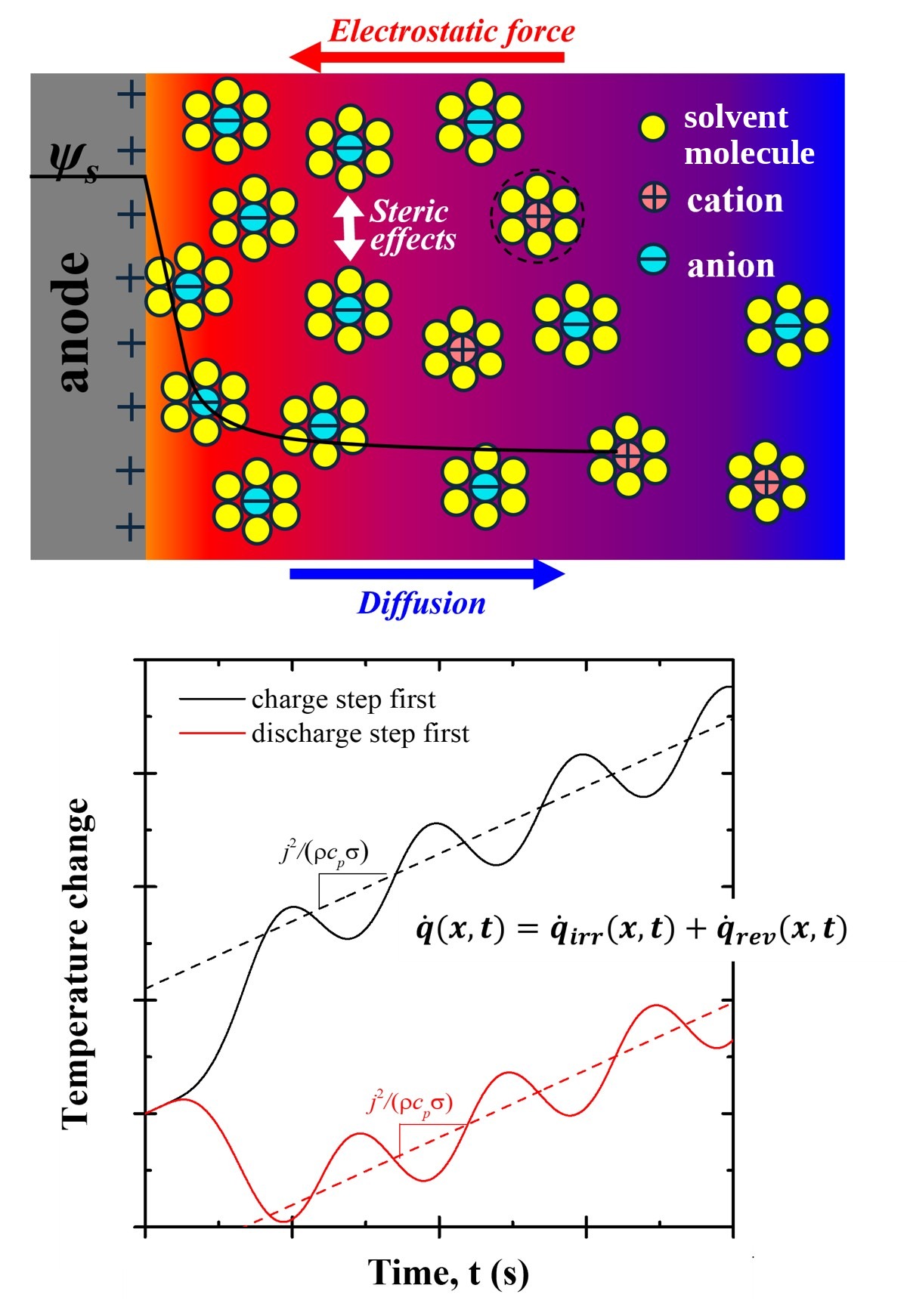
Charging high-power electrochemical capacitors generates heat that may lead to excessive temperatures responsible for accelerated aging, increased self-discharge, and thermal runaway. Heat generation in electrochemical capacitors was typically modeled as Joule heating or with ad hoc models based on intuition.
Our team derived, from first principles, the first thermal models predicting the local heat generation rate in both EDLCs [6] and pseudocapacitors [7] under realistic charging and discharging conditions. We demonstrated that not only Joule heating but also ion adsorption/desorption, ion diffusion, steric effects, entropy of mixing, and redox reactions contribute to heat generation in significant and non-trivial ways.
- [6]A.L. d'Entremont and L. Pilon, First Principles Thermal Modeling of Electric Double Layer Capacitors Under Constant-Current Cycling, Journal of Power Sources, Vol. 246, pp. 887- 898 (2014).DOIPDFExplainer
- [7]A.L. d'Entremont and L. Pilon, First-Principles Thermal Modeling of Hybrid Pseudocapacitors under Galvanostatic Cycling, Journal of Power Sources, Vol. 335, pp. 172-188 (2016).DOIPDFExplainer
First operando calorimeter measuring heat generation at each electrode
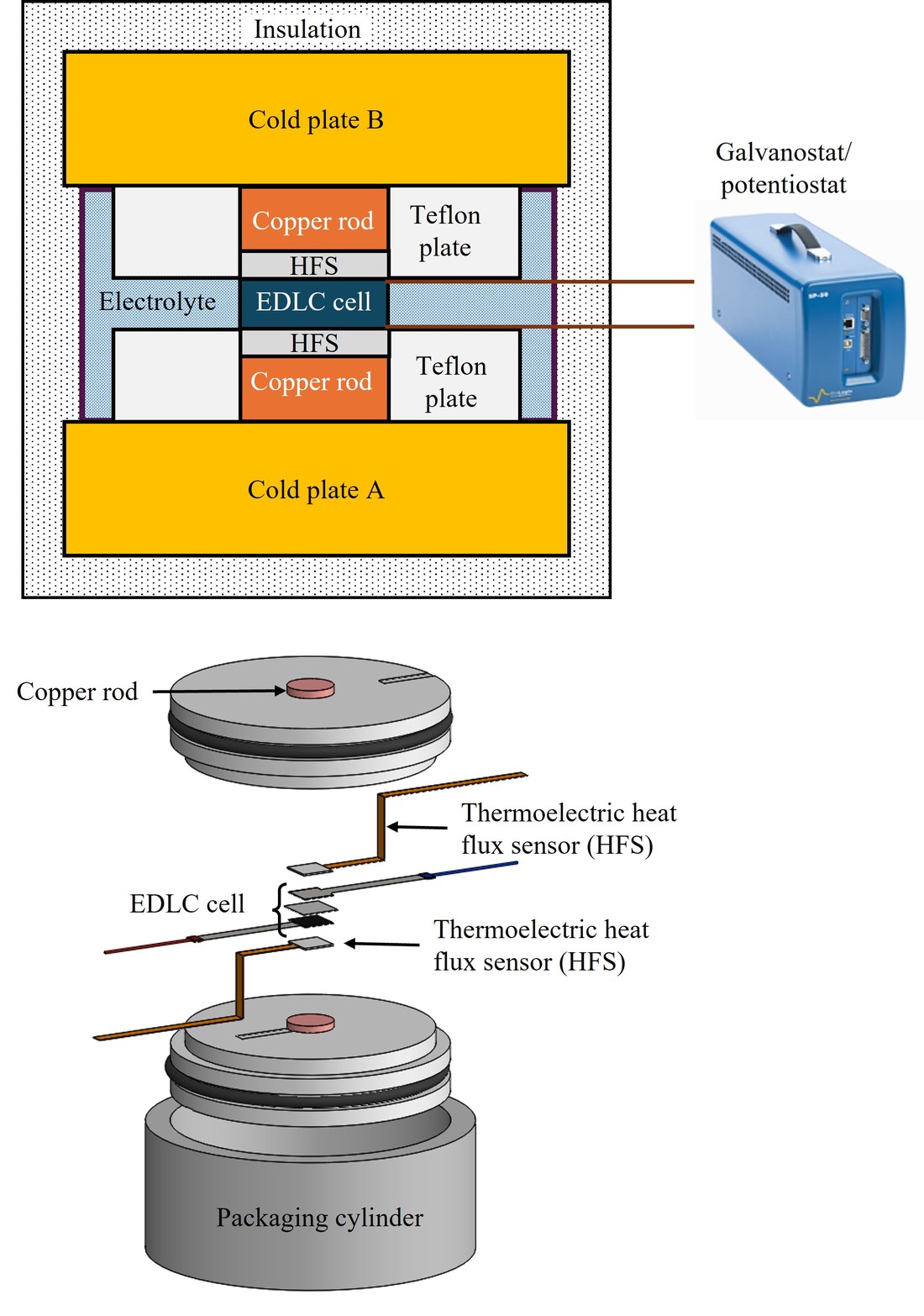
Building on our thermal models, our team developed the first operando calorimeter capable of independently measuring the instantaneous heat generation rate at each electrode of electrochemical capacitors [8], along with the data analysis needed to distinguish reversible from irreversible heat generation. We demonstrated the validity of the device and analysis for carbon-based [8] and redox-active [9] electrodes.
We established that calorimetry can identify, through their thermal signature, the electrochemical and transport processes occurring at each electrode at different times during charging and discharging. This powerful method adds a new modality to existing electrochemical techniques. The device and method have been used to observe ion adsorption/desorption, ion solvation/desolvation, ion intercalation/deintercalation, electrolyte decomposition, and lithium plating/stripping.
- [8]O. Munteshari, J. Lau, A. Krishnan, B. Dunn, and L. Pilon, Isothermal Calorimeter for Measurements of Time-Dependent Heat Generation Rate in Individual Supercapacitor Electrodes, Journal of Power Sources, Vol. 374, pp. 257–268 (2018).DOIPDFExplainer
- [9]O. Munteshari, J. Lau, A. Likitchatchawankun, B.-A. Mei, C.S. Choi, D. Butts, B.S. Dunn, L. Pilon, Thermal signature of ion intercalation and surface redox reactions mechanisms in model pseudocapacitive electrodes, Electrochimica Acta, Vol. 307, pp. 512-524 (2019).DOIPDF
Thermal and entropic signatures of fast-charging battery electrodes
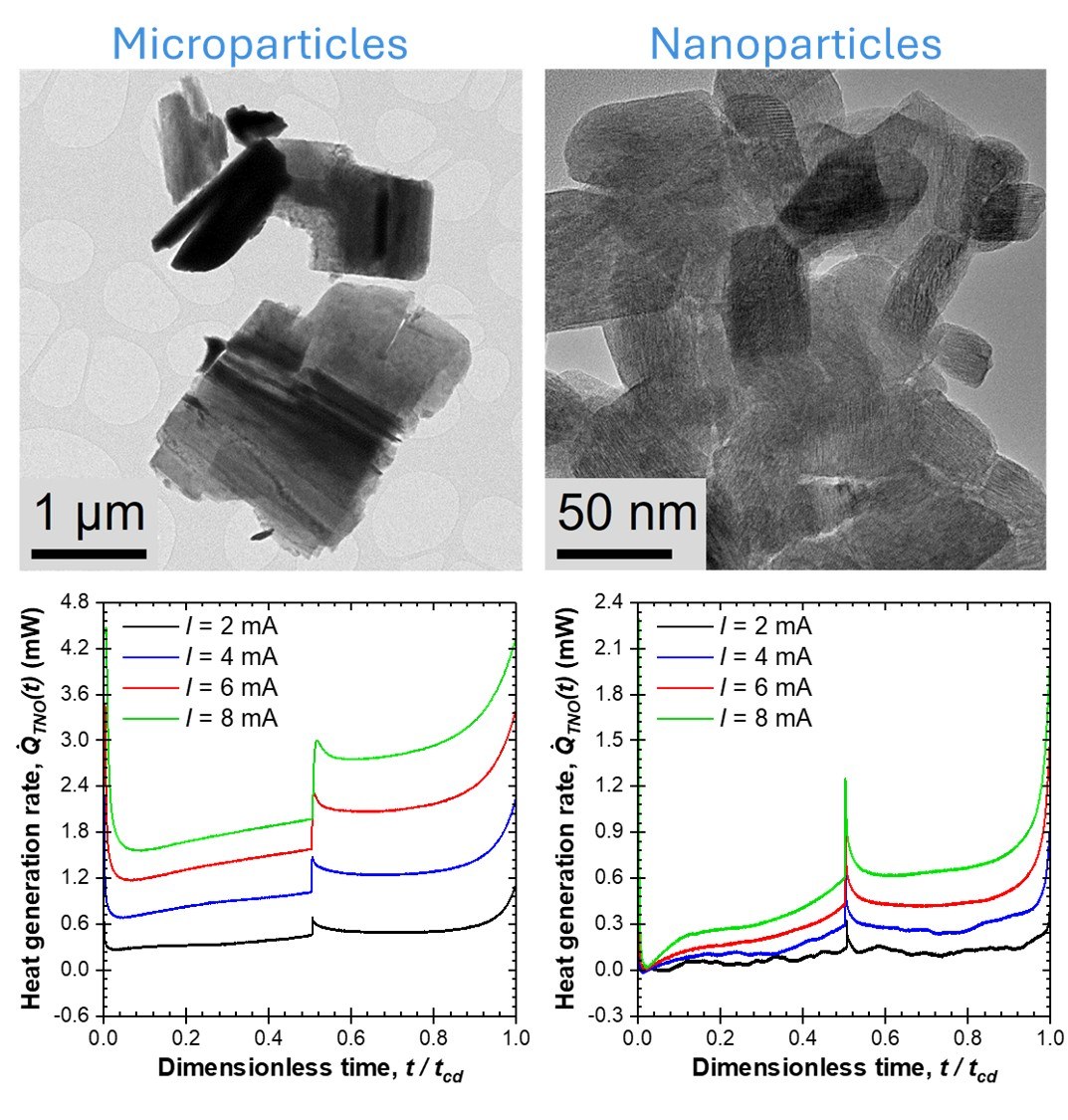
Our team extended operando calorimetry and potentiometric entropy measurements to lithium-ion battery electrodes. We developed a thermodynamic analysis and interpretative guide for entropic potential measurements of battery electrodes [10]. In particular, this technique can identify intercalated lithium-ion ordering. Combined with operando calorimetry, these measurements revealed the mechanisms responsible for the fast-charging capability of niobium-based anodes such as PNb₉O₂₅ [11] and TiNb₂O₇ [12], and the effect of particle size on thermodynamics and lithium-ion transport in Ti₂Nb₂O₉ electrodes [13].
We also measured heat dissipation and entropic potential in battery cathodes made with conjugated and conventional polymer binders [14], and performed electrothermal impedance spectroscopy (ETIS) measurements of lithium-ion battery cells using operando isothermal calorimetry [15].
- [10]S.W. Baek, M. Saber, A. Van der Ven, L. Pilon, Thermodynamic Analysis and Interpretative Guide to Entropic Potential Measurements of Lithium-Ion Battery Electrodes, Journal of Physical Chemistry C, Vol. 126 No. 14, pp. 6096-6110 (featured article) (2022).DOIPDF
- [11]S.W. Baek, M.B. Preefer, M. Saber, K. Zhai, M. Frajnkovič, Y. Zhou, B.S. Dunn, A. Van der Ven, R. Seshadri, L. Pilon, Potentiometric Entropy and Operando Calorimetric Measurements Reveal Fast-Charging Mechanisms in PNb9O25, Journal of Power Sources, Vol. 520, 230776 (2022).DOIPDF
- [12]S.W. Baek, K.E. Wyckoff, D.M. Butts, J. Bienz, A. Likitchatchawankun, M.B. Preefer, M. Frajnkovič, B.S. Dunn, R. Seshadri, L. Pilon, Operando Calorimetry Informs the Origin of Rapid Rate Performance in Microwave-Prepared TiNb2O7 Electrodes, Journal of Power Sources, Vol. 490, 229537 (2021).DOIPDF
- [13]Y. Zhou, E. Le Calvez, S.W. Baek, M. Frajnkovič, C. Douard, E. Gautron, O. Crosnier, T. Brousse, L. Pilon, Effect of Particle Size on Thermodynamics and Lithium Ion Transport in Electrodes Made of Ti2Nb2O9 Microparticles or Nanoparticles, Energy Storage Materials, Vol. 52, pp. 371-385 (2022).DOIPDF
- [14]S.W. Baek, C. Z. Salamat, R. Elizalde-Segovia, P. Das, M. Frajnkovič, Y. Zhou, B.C. Thompson, S. R. Narayan, S. H. Tolbert, L. Pilon, Measuring Heat Dissipation and Entropic Potential in Battery Cathodes Made with Conjugated and Conventional Polymer Binders Using Operando Calorimetry, ACS Applied Polymer Materials, Vol. 6, No. 9, pp. 4954-4963 (2024).DOIPDF
- [15]Y. Zhou, Y. Luo, A. Patterson, S.W. Baek, M. Frajnkovič, R. Seshadri, B.S. Dunn, L. Pilon, Microcalorimetry Electrothermal Impedance Spectroscopy (ETIS) Informs Entropy Evolution at Individual Electrodes of PNb9O25 or TiNb2O7 Battery Cells, Electrochimica Acta, Vol. 468, 143072 (2023).DOIPDF