Photobiological CO₂ conversion into biofuels
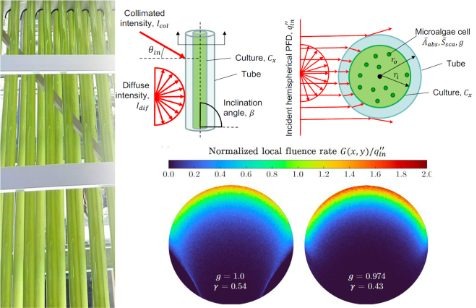
Microalgae and cyanobacteria use sunlight to convert CO₂ into biomass and lipids for biofuels. They can also produce hydrogen and other high-value products under specific conditions. Well-mixed replete dense cultures can be achieved by continuous addition of nutrients and CO₂. By contrast, light cannot be mixed and is often the limiting resource. Cells near the illuminated surface absorb most of the incident light while cells deeper in the culture receive too little. Designing and operating productive photobioreactors (PBRs) therefore requires knowing how much light each cell absorbs, which in turn depends on how cells absorb and scatter light.
Since 2007, our team has built the radiation transfer foundations of photobiological energy conversion, from measuring and predicting the optical properties of individual cells to designing photobioreactors and outdoor ponds. Some of this work was done in collaboration with Profs. Jeremy Pruvost and Jack Legrand and their colleagues Profs. Guillaume Cogne, Mariana Titica, and Dominique Grizeau of the GEPEA Laboratory at Nantes University (France) through sabbatical visits and exchange of Ph.D. students.
Measuring the radiation characteristics of photosynthetic microorganisms
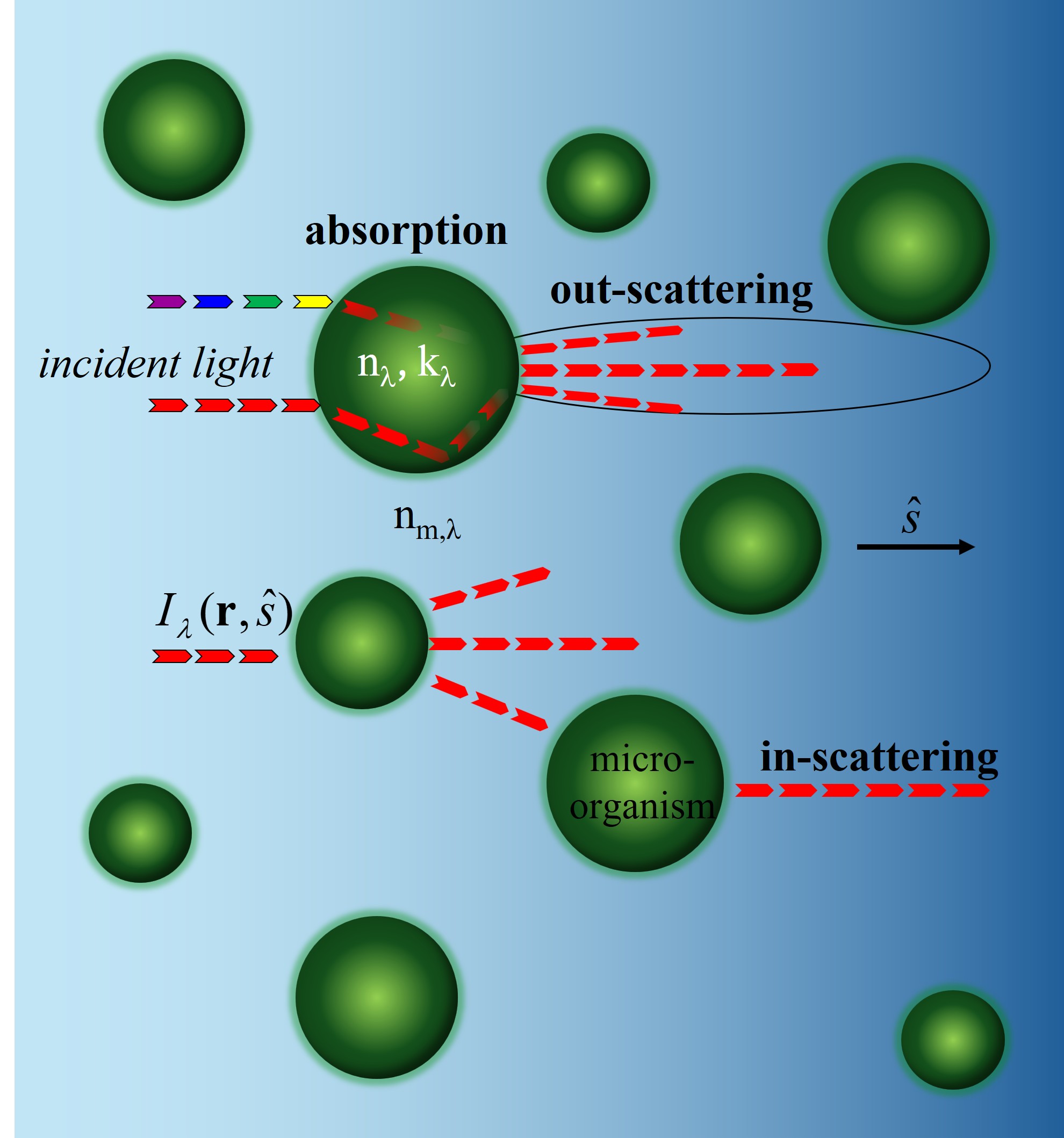
Light transfer models require the absorption and scattering cross-sections and the scattering phase function of the cells, but such data were largely unavailable for species of interest for biofuel and hydrogen production. Our team developed experimental methods to measure these radiation characteristics across the photosynthetically active spectrum and reported them for photosynthetic bacteria and green microalgae relevant to hydrogen and biofuel production [1–3] (see Research data section).
We showed that radiation characteristics change with growth conditions, such as irradiance and spectrum, and over the course of a batch culture [4, 5]. We also developed a simple method to measure the spectral absorption cross-section of microalgae with a standard spectrophotometer [6] and shared the associated data.
- [1]H. Berberoğlu and L. Pilon, Experimental Measurements of the Radiation Characteristics of Anabaena variabilis ATCC 29413-U and Rhodobacter sphaeroides ATCC 49419, International Journal of Hydrogen Energy,Vol. 32, No. 18, pp.4772-4785 (2007).DOIPDFExplainer
- [2]H. Berberoğlu, L. Pilon, and A. Melis, Radiation Characteristics of Chlamydomonas reinhardtii CC125 and Its Truncated Chlorophyll Antenna Transformants tla1, tlaX, and tla1-CW+, International Journal of Hydrogen Energy, Vol. 33, No.22, pp. 6467–6483 (2008).DOIPDFExplainer
- [3]H. Berberoğlu, P. Gomez, and L. Pilon, Radiation Characteristics of Botryococcus braunii, Chlorococcum littorale, and Chlorella sp. Used for CO2 Fixation and Biofuel Production, Journal of Quantitative Spectroscopy and Radiative Transfer, Vol. 110, pp. 1879–1893 (2009).DOIPDFExplainer
- [4]R. Kandilian, E. Lee, and L. Pilon, Radiation and Optical Properties of Nannochloropsis oculata Grown Under Different Irradiances and Spectra, Bioresource Technology, Vol. 137, pp. 63-73 (2013).DOIPDFExplainer
- [5]R.-L. Heng and L. Pilon, Time-Dependent Radiation Characteristics of Nannochloropsis Oculata During Batch Culture, Journal of Quantitative Spectroscopy and Radiation Transfer, Vol. 144, pp. 154-163 (2014).DOIPDF
- [6]R. Kandilian, A. Soulies, J. Pruvost, B. Rousseau, J. Legrand, and L. Pilon, Simple Method for Measuring the Spectral Absorption Cross-Section of Microalgae, Chemical Engineering Science, Vol. 146, No. 2, pp. 357-368 (2016).DOIPDF
Predicting radiation characteristics from cell composition and morphology
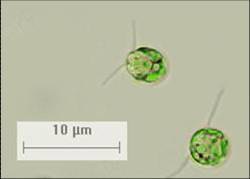
Because measurements are time-consuming and optical properties change with culture conditions, our team developed methods to predict radiation characteristics from the content of pigments, starch, and lipids, as well as cellular morphology. We retrieved the optical constants of microalgae [7], examined when cells can be treated as optically homogeneous spheres despite their internal structure [8], and compared experimentally and theoretically determined radiation characteristics [9].
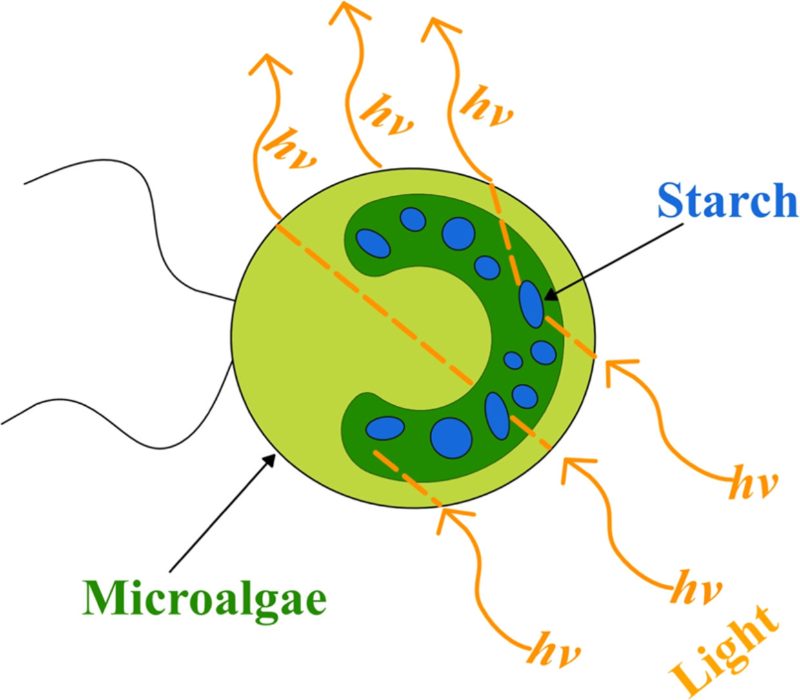
We extended these methods to complex morphologies, such as fractal aggregates and cell colonies [10, 11], and recently predicted how the radiation characteristics and light absorption rate of Chlamydomonas reinhardtii evolve as the cells accumulate carbon reserves under nitrogen starvation [12].
- [7]E. Lee, R.-L. Heng, and L. Pilon, Spectral Optical Properties of Selected Photosynthetic Microalgae Producing Biofuels, Journal of Quantitative Spectroscopy and Radiation Transfer, Vol. 114, pp.122-135 (2013).DOIPDFExplainer
- [8]A. Bhowmik and L. Pilon, Can Spherical Eukaryotic Microalgae Cells Be Treated as Optically Homogeneous?, Journal of the Optical Society of America A, Vol. 33, No. 8, pp. 1495-1503 (2016).DOIPDFExplainer
- [9]R. Kandilian, J. Pruvost, A. Artu, C. Lemasson, J. Legrand, and L. Pilon, Comparison of Experimentally and Theoretically Determined Radiation Characteristics of Photosynthetic Microorganisms, Journal of Quantitative Spectroscopy and Radiative Transfer, Vol. 175, pp. 30-45 (2016).DOIPDF
- [10]R. Kandilian, R.-L. Heng, and L. Pilon, Absorption and Scattering by Fractal Aggregates and by Their Equivalent Coated Spheres, Journal of Quantitative Spectroscopy and Radiative Transfer, Vol. 151, pp. 310-326 (2015).DOIPDF
- [11]J. Hoeniges, R. Kandilian, C. Zhang, J. Pruvost, J. Legrand, D. Grizeau, L. Pilon, Effect of Colony Formation on Light Absorption by Botryococcus braunii, Algal Research, Vol. 50, 101985 (2020).DOIPDF
- [12]F.R. Ferrel Ballestas, M. Titica, J. Legrand, L. Pilon, G. Cogne, Prediction of the Radiation Characteristics and the Light Absorption Rate of Chlamydomonas reinhardtii Cultivated Under a Progressive Nitrogen Starvation and Accumulating Carbon Reserves, Journal of Quantitative Spectroscopy and Radiation Transfer, Vol. 309, 108708 (2023).DOIPDF
Linking light transfer to growth and productivity
Our team developed the first comprehensive model for bubble-sparged photobioreactors that accounts for anisotropic scattering by both the gas bubbles and the microorganisms across the photosynthetically active region. We showed that large bubbles scatter light strongly forward, contributing to deeper light penetration into the photobioreactor [13, 14].
Combining light transfer models with growth kinetics, we developed a design tool and guidelines for outdoor photobioreactors [15] and a strategy to control the incident irradiance on a flat-plate photobioreactor during batch operation [16].
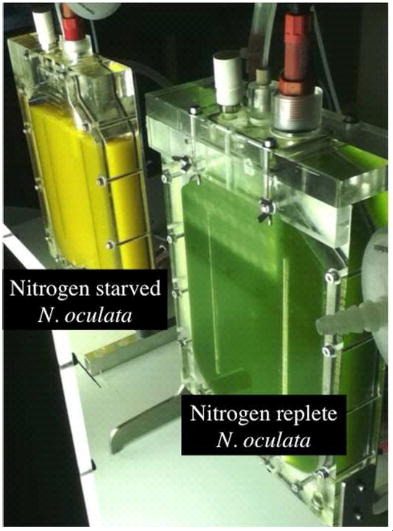
We also showed that the rate at which cells absorb light governs triglyceride (lipid) production by Nannochloropsis oculata during nitrogen starvation, identifying a key parameter for optimizing biofuel production.
- [13]L. Pilon, H. Berberoglu, and R. Kandilian, Radiation Transfer in Photobiological Carbon Dioxide Fixation and Fuel Production by Microalgae, Journal of Quantitative Spectroscopy and Radiation Transfer, Vol. 112, No. 17, pp. 2639–2660 (2011).DOIPDFExplainer
- [14]H. Berberoğlu, J. Yin, and L. Pilon, Light transfer in bubble sparged photobioreactors for H2 production and CO2 mitigation, International Journal of Hydrogen Energy, Vol. 32, no.13, pp. 2273 – 2285 (2007).DOIPDFExplainer
- [15]E. Lee, J. Pruvost, X. He, R. Munipalli, and L. Pilon, Design Tool and Guidelines for Outdoor Photobioreactors, Chemical Engineering Science, Vol. 106, pp. 18-29 (2014).DOIPDF
- [16]R. Kandilian, T.C. Tsao, and L. Pilon, Control of Incident Irradiance on a Batch Operated Flat-Plate Photobioreactor, Chemical Engineering Science, Vol. 119, pp. 99-108 (2014).DOIPDF
- [17]R. Kandilian, J. Pruvost, J. Legrand, and L. Pilon, Influence of Light Absorption Rate by Nannochloropsis oculata on Triglyceride Production During Nitrogen Starvation, Bioresource Technology, Vol. 163, pp. 308–319 (2014).DOIPDF
Engineering photobioreactors and outdoor ponds
Our team has addressed practical issues that limit outdoor cultivation. We quantified how dropwise condensation on transparent photobioreactor walls alters light transmission [18] and reduces biomass productivity [19], proposed a raceway pond design with external reflectors to increase biomass productivity [20], and used Monte Carlo ray tracing to investigate light transfer in solar tubular photobioreactors [21].
- [18]Y. Huang, C. Feng, J. Hoeniges, K. Zhu, and L. Pilon, Bidirectional Transmittance of Transparent Windows With External or Backside Condensation of Nonabsorbing Cap-Shaped Droplets, Journal of Quantitative Spectroscopy and Radiative Transfer, Vol. 251, 107039 (2020).DOIPDF
- [19]J. Hoeniges, K. Zhu, J. Pruvost, J. Legrand, E. Si-Ahmed, L. Pilon, Impact of Dropwise Condensation on the Biomass Production Rate in Covered Raceway Ponds, Invited in the Special Issue "Conception, Modelling, Control, and Intensification of Photobioreactors Applied to the Valorization of Microalgae", J. Legrand, Editor, Energies, Vol. 14, 268 (2021).DOIPDF
- [20]J. Hoeniges, W. Welch, J. Pruvost, L. Pilon, A Novel External Reflecting Raceway Pond Design for Improved Biomass Productivity, Algal Research, Vol. 65, 102742 (2022).DOIPDF
- [21]J. Hoeniges, L. Pilon, J. Dauchet, J. Pruvost, Light Transfer Investigation in Solar Tubular Photobioreactors Using Monte Carlo Ray Tracing, Chemical Engineering Journal Advances, Vol. 26, 101081 (2026).DOIPDF