Motivations
In order to simulate light transfer in photobioreactors used for hydrogen production and carbon dioxide mitigation one needs to solve the radiation transfer equation (RTE) given as,
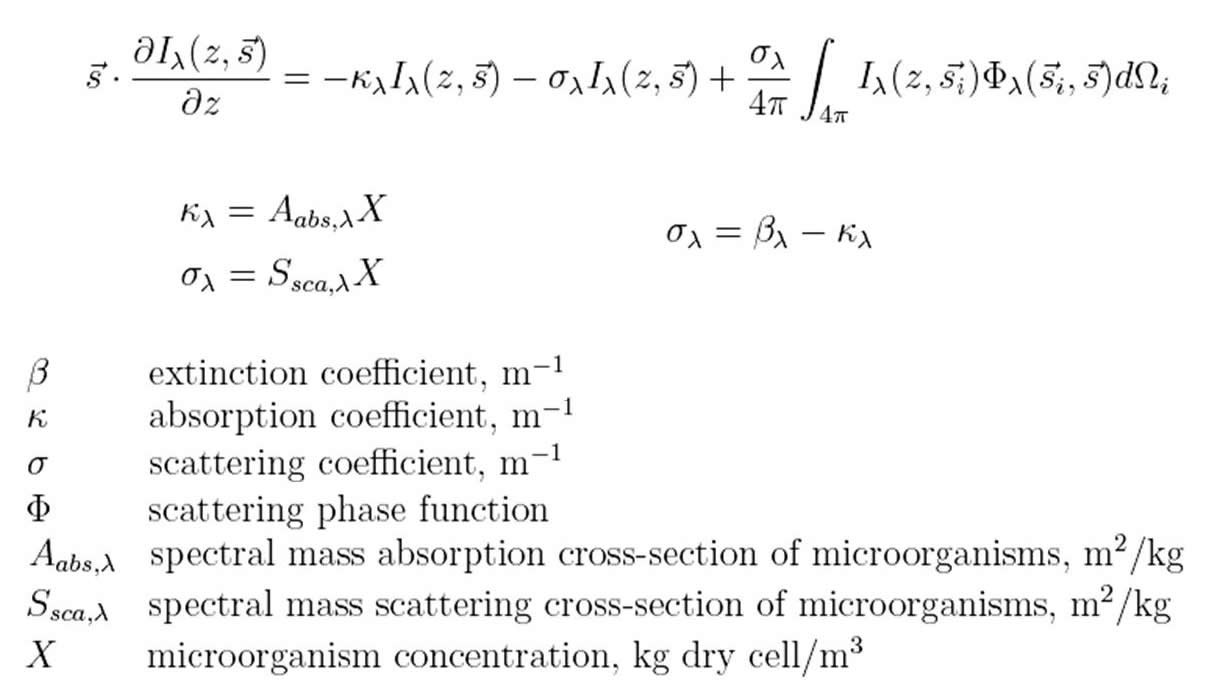
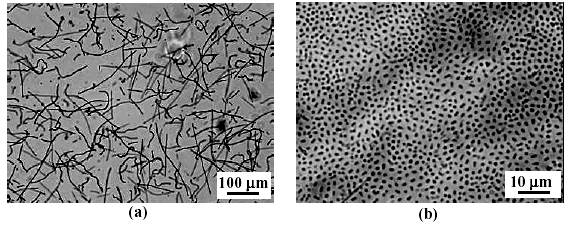
To be able to solve the RTE, one needs to experimentally or theoretically predict the radiation characteristics (or optical properties) of bacteria. Given the complex shape of the bacteria investigated and the fact that we do not know there index of refraction, it was chosen to experimentally measure the corresponding values of Aabs,λ, Ssca,λ, and Φλ.
Nephelometer: Measuring Scattering Phase Function of Microalgae
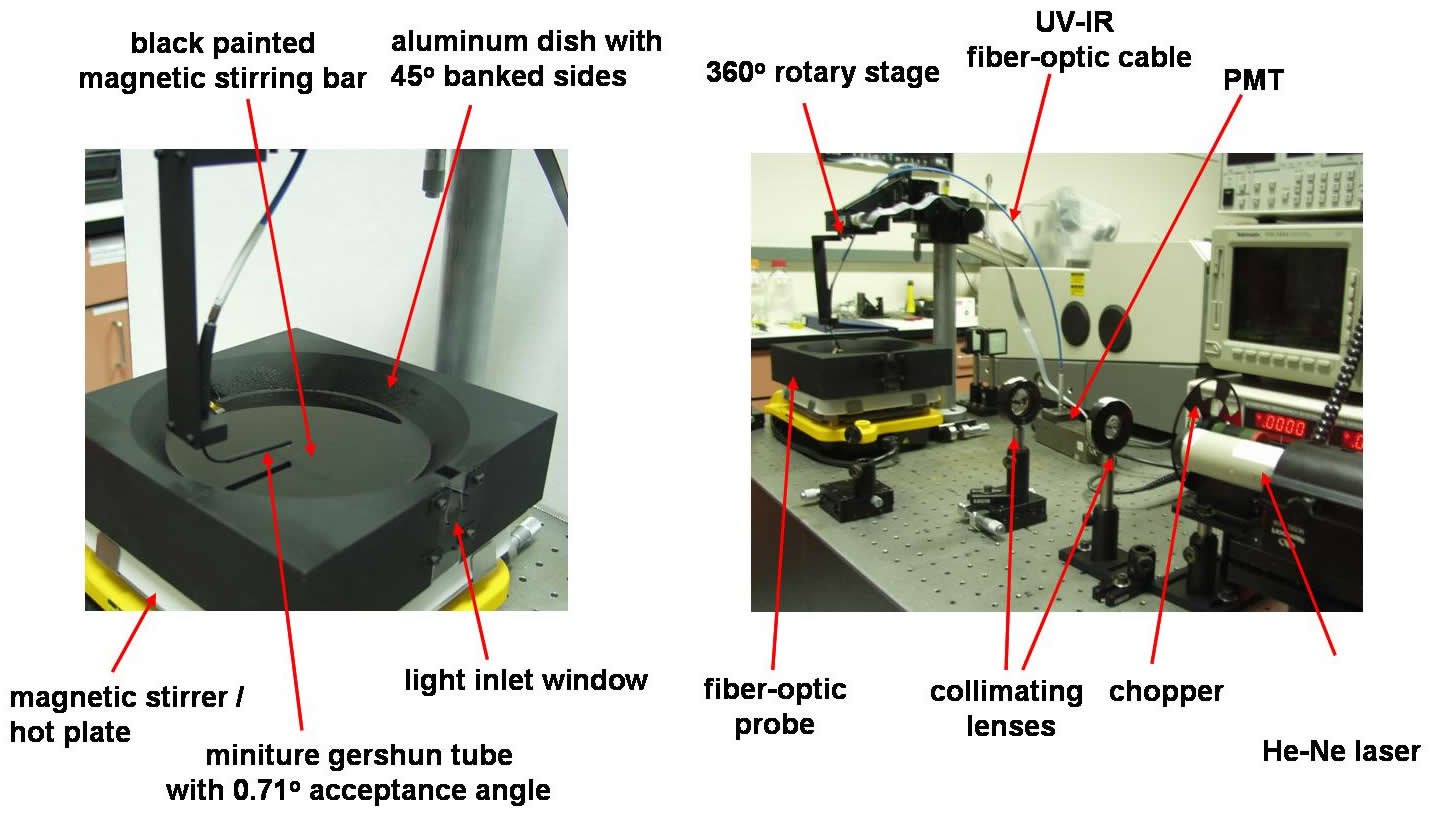
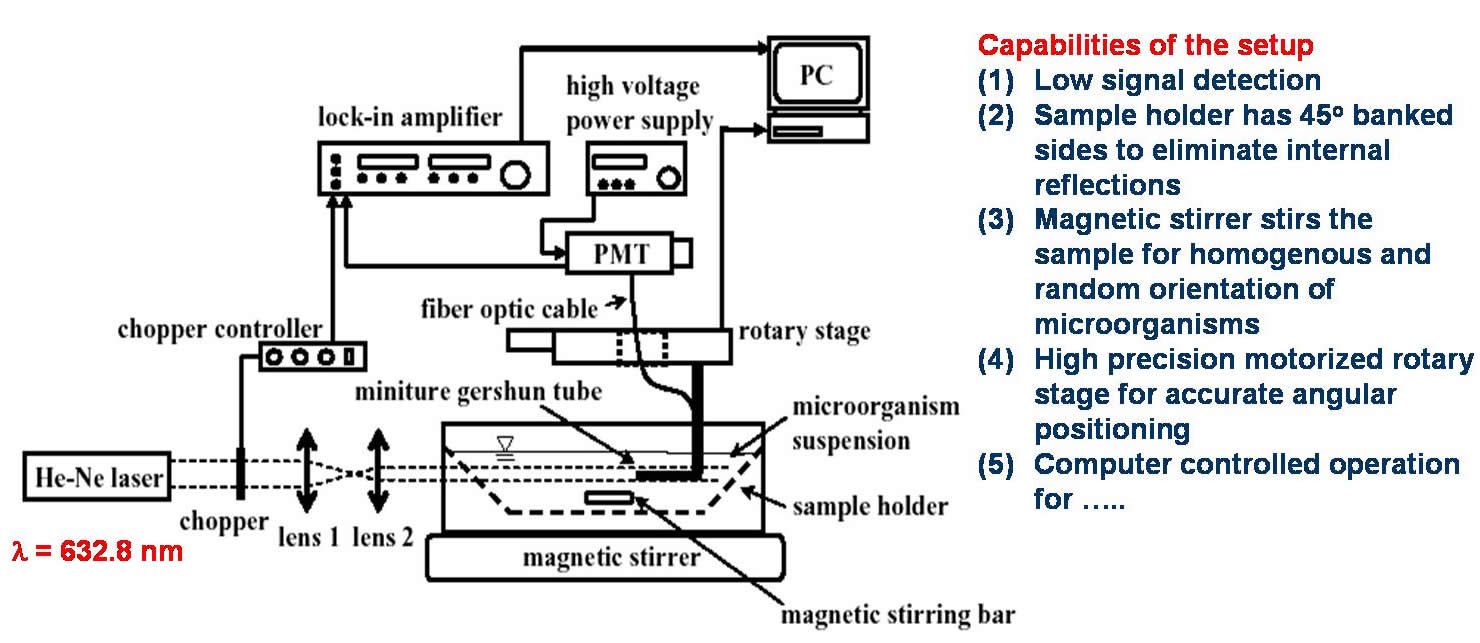
Validation of the experimental setup and the data analysis was achieved by measuring the scattering phase function of particles of known size and diameters namely
- polystyrene microspheres of diameter 19 microns with complex index of refraction m = 1.58 - i 0.00045.
- 1 cm long fiber glass with diameter between 15 and 20 microns randomly oriented with m = 1.45 - i 0.0000001.
Absorption and Extinction Coefficients of Microalgae
Extinction Coefficient

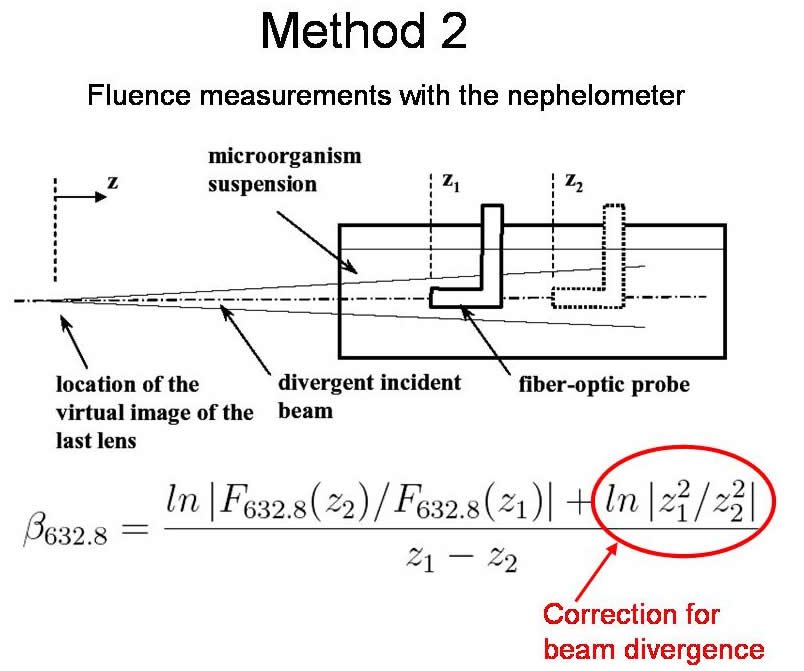
Methods 1 and 2 agree within 7.5 % at 632.8 nm
Absorption Coefficient
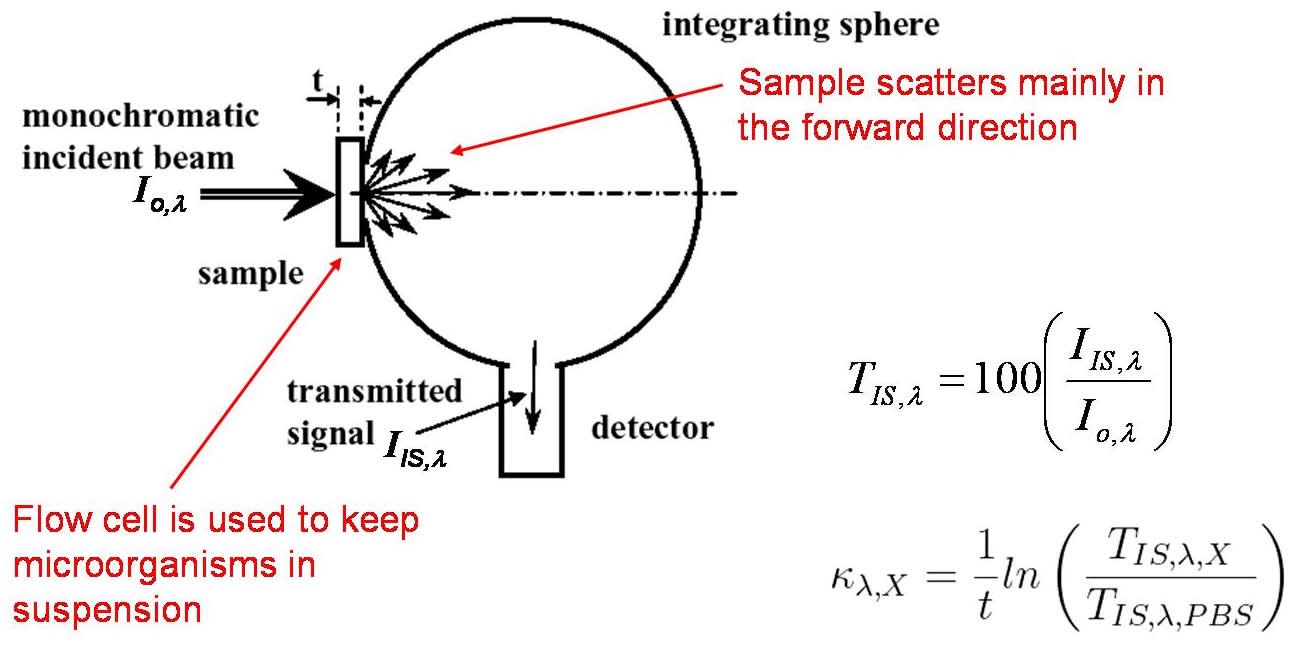
Publications
- H. Berberoğlu, P. Gomez, and L. Pilon, 2009. Radiation Characteristics of Botryococcus braunii, Chlorococcum littorale, and Chlorella sp. Used for CO2 Fixation and Biofuel Production, Journal of Quantitative Spectroscopy and Radiative Transfer, Vol. 110, pp. 1879–1893.DOIPDF
- H. Berberoğlu, L. Pilon, and A. Melis, 2008. Radiation Characteristics of Chlamydomonas reinhardtii CC125 and Its Truncated Chlorophyll Antenna Transformants tla1, tlaX, and tla1-CW+, International Journal of Hydrogen Energy, Vol. 33, No.22, pp. 6467–6483.DOIPDF
- H. Berberoğlu and L. Pilon, 2007. Experimental Measurements of the Radiation Characteristics of Anabaena variabilis ATCC 29413-U and Rhodobacter sphaeroides ATCC 49419, International Journal of Hydrogen Energy,Vol. 32, No. 18, pp.4772-4785.DOIPDF