Motivation
Porous crystalline silicon have received significant attention due to their wide range of applications including (i) optoelectronic devices, (ii) thermal insulator and sensor, (iii) highly energetic MEMS devices, as well as in (iv) thermoelectric devices for energy harvesting. In all these applications, knowledge of the thermal properties of these materials over a wide range of temperature is of significant importance for their practical implementation in devices. Predicting the thermal conductivity of nanoporous materials is very challenging because of the presence of nanopores presenting large matrix/pore interfacial area and resistance to energy transport through the nanostructure. Through classical molecular dynamics (MD) simulations, our study aims to provide insight into the physical phenomena controlling energy transport in nanostructured materials.
Simulation Systems and Method

Results and Scaling Analysis



Conclusion
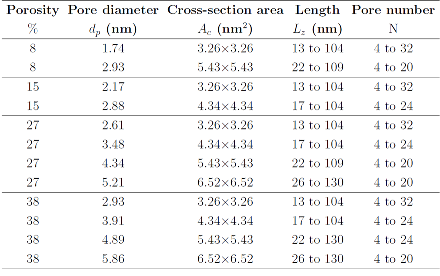
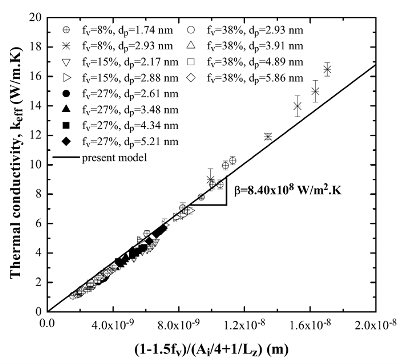
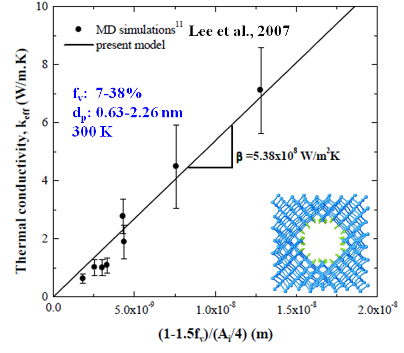
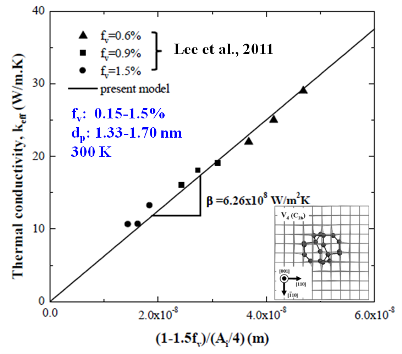
This study established that the effective thermal conductivity keff of crystalline nanoporous silicon predicted from non-equilibrium MD simulations is strongly affected by the pore interfacial area concentration Ai, the porosity fv, and the system's length Lz. In addition, a modified effective medium approximation combining kinetic theory and the coherent potential approximation suggested that keff was proportional to (1-1.5fv) and inversely proportional to the sum (Ai/4+1/Lz). This model agreed with MD simulation predictions for the thermal conductivity of crystalline nanoporous silicon with not only spherical pores (present study) but also with cylindrical pores and vacancy defects, reported in the literature. These results will be useful in designing nanostructured materials with desired thermal conductivity by tuning their morphology for various applications including thermoelectric energy conversion.