Abstract
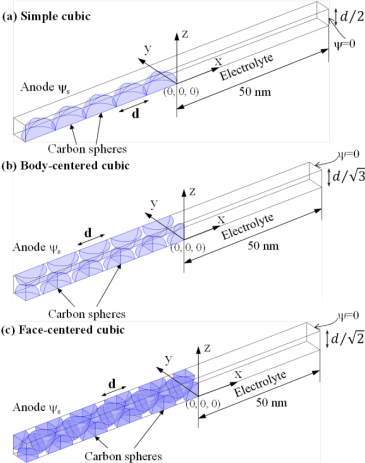
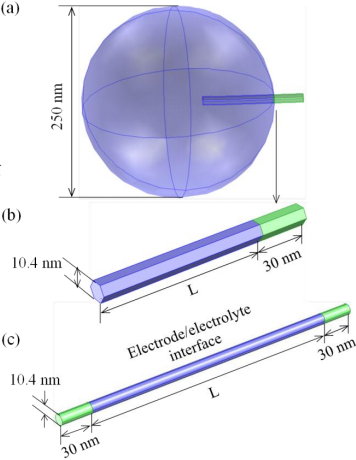
This paper aims to numerically predict the capacitance of electric double layer capacitors (EDLCs) made of mesoporous electrodes consisting of closely packed monodispersed mesoporous carbon spheres in (C2H5)4NBF4/propylene carbonate electrolyte. The model faithfully accounts for the electrode packing morphology and the dependency of electrolyte dielectric permittivity on local electric field. Three sphere packing morphologies were investigated, namely, simple cubic (SC), body-centered cubic (BCC), and facecentered cubic (FCC). A cylindrical mesopore in a mesoporous carbon sphere was also simulated. This study demonstrates that the field-dependent electrolyte dielectric permittivity significantly affects the predicted capacitance of EDLCs. Moreover, the Stern layer needs to be accounted for in order to match predicted specific area capacitance with experimental data. This study also establishes that, for all packing structures, larger sphere diameter results in larger electric field at the electrode surface and thus larger diffuse layer specific area capacitance. For sphere diameter less than 40 nm, SC packing had the largest electrolyte volume fraction. This provided more space for the electric potential to decrease resulting in larger electric field at the electrode surface and diffuse layer specific area capacitance compared with BCC and FCC packings. On the contrary, FCC features the smallest volume fraction resulting in the lowest surface electric field and diffuse layer specific area capacitance. The packing morphologies of electrode spheres were found to have no significant effect on the diffuse layer specific area capacitance for sphere diameter larger than 40 nm.
Objectives
This study aims to (i) clarify the fundamental physical mechanisms to be accounted for in simulating EDLCs and (ii) identify how the electrode morphology affects the capacitance of EDLCs. It is unique in that it accounts for (i) the accurate electrode morphology, (ii) the non-uniform ion concentration and electric potential distribution in the electrolyte, as well as (iii) the dependency of the electrolyte dielectric permittivity on the electric field.
Electric Double Layer Structure: Stern Model
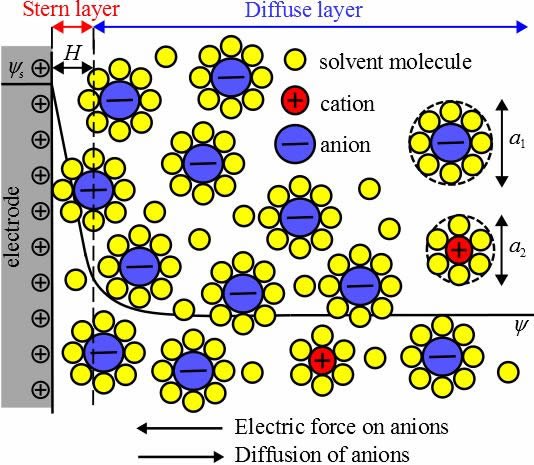
The EDL is the region of net space charge near the electrode/electrolyte interface, in contrast to the electrically neutral bulk electrolyte. The ionic charge of the EDL in the electrolyte is equal and opposite to the electronic surface charge in the electrode so that the interface is electrically neutral overall. Figure 1 illustrates the electric double layer (EDL) near a planar electrode according to the Stern model. The electrolyte can be divided into the Stern and diffuse layers. The Stern layer is adjacent to the electrode surface and contains no free charge. By contrast, ions in the diffuse layer move under the coupled influences of electrostatic forces, diffusion, and steric effects. The Stern/diffuse layer interface corresponds to the distance of closest approach to the electrode surface for a solvated ion.
Effect of electrode morphology on the capacitance of EDLCs
Three-dimensional (3D) equilibrium and heterogeneous model based on continuum theory was developed to predict the specific area capacitance of electrodes made of closely-packed spheres and of cylindrical mesopores immersed in an electrolyte. It accounts for (i) the accurate electrode morphology, (ii) the non-uniform ion concentration and electric potential distribution in the electrolyte, as well as (iii) the dependency of the electrolyte dielectric permittivity on the electric field.
Results

Conclusions
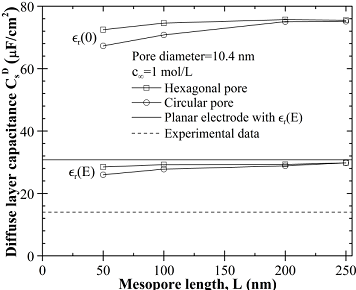
- The field-dependent permittivity εr(E) significantly affects the predicted diffuse and Stern layer capacitances of EDLCs.
- The Stern layer capacitance needs to be accounted for in order to find good agreement between the predicted and experimental specific area capacitance for high electrolyte concentrations and electric potentials typically encountered in EDLCs.
- For a given sphere packing, the diffuse layer specific area capacitance increased with increasing diameter. Larger spheres provided more space for the electric potential to decrease resulting in larger electric field at the electrode surface, and therefore larger diffuse layer specific area capacitance.
- The electrode morphology (SC, BCC, FCC) was found to have no significant effect on the diffuse layer specific area capacitance for sphere diameter larger than 40 nm.
- SC packing featured the largest diffuse layer specific area capacitance compared with BCC and FCC packings due to larger electric field at the electrode surface for sphere diameter smaller than 40 nm.
- The diffuse layer specific area capacitance of closely-packed dense spheres and mesopores reached the same asymptotic value corresponding to that of planar electrodes when sphere and pore diameter was larger than 40 and 10 nm, respectively.
Publications
- H. Wang and L. Pilon, 2011. Accurate Simulations of Electric Double Layer Capacitance of Ultramicroelectrodes, The Journal of Physical Chemistry C, Vol. 115, no. 33, pp 16711–16719.DOIPDF
- J. Varghese, H. Wang, and L. Pilon, 2011. Simulating Electric Double Layer Capacitance of Mesoporous Electrodes with Cylindrical Pores, Journal of the Electrochemical Society. Vol.158, No.10, pp. A1106-A1114.DOIPDF
- H. Wang, J. Varghese, and L. Pilon, 2011. Simulation of Electric Double Layer Capacitors with Mesoporous Electrodes: Effects of Morphology and Electrolyte Permittivity, Electrochimica Acta, Vol. 56, no. 17, pp. 6189-6197.DOIPDF