Motivation
Industrial nations in general and the United States of America in particular are facing an unprecedented combination of economic and environmental challenges. First, they face the formidable challenge to meet expanding energy needs without adding intolerable amounts of greenhouse gases to the atmosphere and further impacting climate and the environment. The reserves of cheap natural resources the world has been relying on for decades are now estimated in tens of years. Evidence of global warming already gathered around the globe and, most likely, due to industrial activities will put an additional stress on the fragile balance we have been enjoying. In order to face these formidable challenges and to create technological and economic opportunities, the United States should reduce its dependency on foreign fossil fuels and rely more on a combination of (i) sustainable energy conversion and transportation systems, (ii) oil-free energy sources, and (iii) new technologies for capturing and converting carbon dioxide.
The objective of this project is to perform a comprehensive study to simultaneously mitigate carbon dioxide and produce hydrogen. It offers a cheap, efficient, scalable, autonomous, and reliable system for producing hydrogen from microbial consumption of carbon dioxide and absorption of solar light.
Principle

Cyanobacteria produce hydrogen and oxygen by (i) consuming the CO2 gas as their carbon source and (ii) absorbing solar light as their energy source.
Anabaena variabilis
Cyanobacteria Anabaena variabilis are:
- Filamentous, heterocystous cyanobacteria.
- Feature high hydrogen production capacity in the absence of nitrogen.
- Considered to be good carbon dioxide consumer.
- Approximately 5 μm in diameter and 100 μm long.
- Their genome has been sequenced.

Photobioreactor Description and Operation
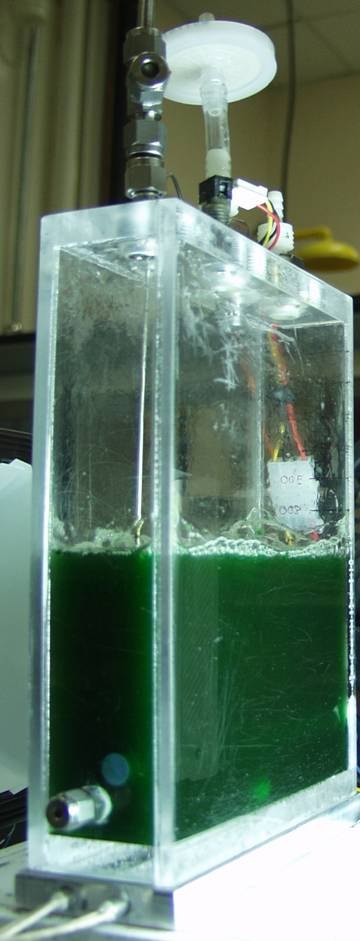
We have designed and built, and now are operating a fully instrumented photobioreactor. The following measurements are systematically performed:

The following quantities are monitored:
- Environment: incident light intensity
- Liquid phase: temperature, pH, dissolved O2, nitrates, and ammonia
- Gas phase: in-flow rate, out-flow rate, pressure, and gas composition (O2, H2, CO2, and N2)
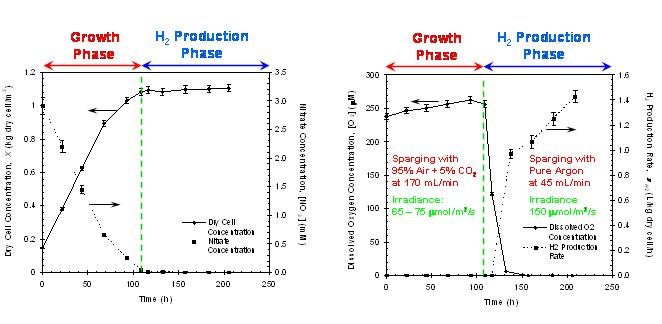
The photobioreactor is operated using two stages. Switching from Stage 1 to Stage 2 takes place when the nitrate concentrations in the liquid phase vanishes.
Stage 1: Carbon Dioxide Consumption and Bacterial Growth
- presence of nitrates and nitrogen.
- sparging with 95% air and 5% CO2 at 170 mL/min.
- irradiance: 65-75 μmol/m2/s.
Stage 2: hydrogen Production
- absence of nitrates and nitrogen.
- sparging with pure Argon at 45 mL/min.
- irradiance: 150 μmol/m2/s.

Results
- The growth phase lasted 110 hours.
- The H2 production phase lasted more that a week.
- The light to hydrogen energy conversion efficiency reached 0.5%.
- The light to biomass energy conversion efficiency was 4.7%.
Publications
- L. Pilon, H. Berberoglu, and R. Kandilian, 2011. Radiation Transfer in Photobiological Carbon Dioxide Fixation and Fuel Production by Microalgae, Journal of Quantitative Spectroscopy and Radiation Transfer, Vol. 112, No. 17, pp. 2639–2660.DOIPDF
- H. Berberoğlu and L. Pilon, 2010. Maximizing the Solar to H2 Energy Conversion Efficiency of Outdoor Photobioreactors Using Mixed Cultures, International Journal of Hydrogen Energy, Vol. 35, pp. 500-510.DOIPDF
- H. Berberoğlu, P. Gomez, and L. Pilon, 2009. Radiation Characteristics of Botryococcus braunii, Chlorococcum littorale, and Chlorella sp. Used for CO2 Fixation and Biofuel Production, Journal of Quantitative Spectroscopy and Radiative Transfer, Vol. 110, pp. 1879–1893.DOIPDF
- H. Berberoğlu, J. Jay, and L. Pilon, 2008. Effect of Nutrient Media on Photobiological Hydrogen Production by Anabaena variabilis ATCC 29413, International Journal of Hydrogen Energy, Vol. 33, No.4, pp.1172 – 1184.DOIPDF
- H. Berberoğlu and L. Pilon, 2007. Experimental Measurements of the Radiation Characteristics of Anabaena variabilis ATCC 29413-U and Rhodobacter sphaeroides ATCC 49419, International Journal of Hydrogen Energy,Vol. 32, No. 18, pp.4772-4785.DOIPDF
Further reading
L. Pilon and H. Berberoğlu, 2014. Photobiological Hydrogen Production. Handbook of Hydrogen Energy, S.A. Sherif, D.Y. Goswami, E.K. Stefanakos, A. Steinfeld, Eds., CRC Press, Taylor and Francis, Boca Raton, FL. ISBN-13: 978-1420054477.