Motivations
In many materials processing and manufacturing situations such as steel, aluminum, ceramics and glass, gas bubbles can form in liquid and solid phases. The presence of such bubbles affects the thermophysical properties and radiation characteristics of the two-phase system and hence the transport phenomena. For example, in glass melting heat transfer by thermal radiation at high temperature accounts for the major fraction of the total energy supply needed for the fusion and melting of the batch raw materials. Numerous bubbles are generated by the melting of the batch as well as by chemical reactions taking place within the glass melt. Bubbles can be dispersed across the molten glass bath (small void fraction) or build up at the surface of the glass melt to form a foam layer (large void fraction) that acts as an insulator. The presence of foam and of bubbles in general forces the glass manufacturers to consume more fuel and reach higher temperatures in the combustion space in order to melt the batch, to activate the refining reactions, and to obtain the required glass melt temperatures for producing high quality glass. Higher combustion space temperatures not only increase the operating costs, due to large fuel consumption, but also increase NOx emissions and shorten the lifetime of the furnace refractories. Traditional treatments of radiation heat transfer through molten glass neglect the presence of bubbles within the glass melt.
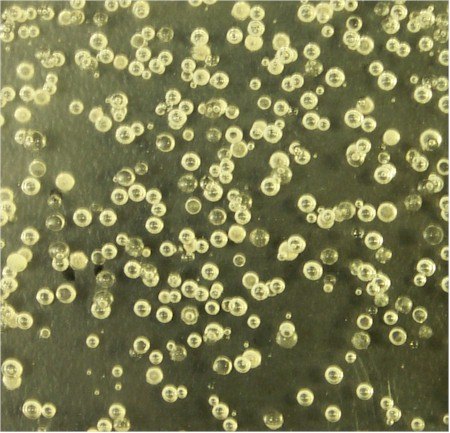
The objective of this study was to mesure and model the effects of bubbles on the effective radiation properties of two-phase mixture as well as on the total apparent transmittance, reflectance, and absorptance of a layer of semitransparent medium containing bubbles. Directional reflectance and transmittance are measured using a Fourier-Transform Infrared Spectrophotometer along with a goniometer in the spectral range from 1.5 to 15 microns as shown below.

Publications
- L. Pilon and R. Viskanta, 2003. Radiation Characteristics of Glass Containing Gas Bubbles, Journal of the American Ceramic Society, Vol.86, No.8, pp.1313-1320.DOIPDF
- D. Baillis, L. Pilon, H. Randrianalisoa, R. Gomez, R. Viskanta, 2004. Measurements of Radiation Characteristics of Fused-Quartz Containing Bubbles, Journal of the Optical Society of America, A. Vol. 21, No.1, pp. 149-159.PDF
- L. Dombrovsky, J. Randrianalisoa, D. Baillis, and L. Pilon, 2005. Use of Mie Theory for Analyzing Experimental Data to Identify Infrared Properties of Fused Quartz Containing Bubbles, Applied Optics, Vol. 44, No. 33, pp. 7021-7031.PDF
- J. Yin and L. Pilon, 2006. Efficiency Factors and Radiation Characteristics of Spherical Scatterers in an Absorbing Medium, Journal of the Optical Society of America, A. Vol. 23, No.11, pp.2784-2796.DOIPDF
- J. Randrianalisoa, D. Baillis, and L. Pilon, 2006. Modeling Radiation Characteristics of Semitransparent Media Containing Bubbles or Particles, Journal of the Optical Society of America, A. Vol. 23, No.7, pp. 1645-1656. Selected to appear in The Virtual Journal for Biomedical Optics, Vol. 1, No. 8, 2006.DOIPDF
- H. Randrianalisoa, D. Baillis, and L. Pilon, 2006. Improved Inverse Method for Radiative Characteristics of Closed-Cell Absorbing Porous Media, Journal of Thermophysics and Heat Transfer, Vol. 20, No.4, pp. 871-883.DOIPDF
- R. Kitamura, L. Pilon, and M. Jonasz, 2007. Optical Constants of Silica Glass from Extreme Ultraviolet to Far Infrared at Near Room Temperature, Applied Optics, Vol. 46, No. 33, pp. 8118-8133.DOIPDF
- A. Bhanawat, R.A. Yalcin, R. Martinez, L. Pilon, 2023. Critical Review and Experimental Validation of Radiative Transfer Models for Semitransparent Media Containing Large Gas Bubbles, Journal of Quantitative Spectroscopy and Radiative Transfer, Vol. 311, 108781.DOIPDF